

Our users reported over 96% customer satisfaction for the last 10 years. Schedule a personal tour of our software to see how we can improve your business’s productivity.
Table of Contents
Share Article
Keeping track of labor in California isn’t as simple as punch-in, punch-out.
California’s timekeeping laws govern how contractors track employee hours, overtime and breaks — and it’s not as simple as punch-in/punch-out.
Contractors operating in the Golden State face some of the most complex and strictly enforced labor laws in the country that can change how you manage overtime, breaks and even how you pay workers on a piece-rate basis.
According to the State of California Department of Industrial Relations (CADIR), individual construction companies have even been hit with citations exceeding $1.7 million for wage theft violations alone.
And the stakes are high. Missteps in time tracking or construction payroll can mean back pay, penalties or lawsuits.
In fact, construction is one of the top-cited industries by the California Division of Labor Standards Enforcement (DLSE). In August, investigators from the Bureau of Field Enforcement issued $2.3 million in citations to developers for wage theft of 124 construction workers.
Whether you’re running a small crew in Fresno or managing multiple projects across the state, understanding California timekeeping laws is key to protecting your business and your workforce.
Let’s break down what you need to know.
Key Takeaways
- California timekeeping laws are state labor regulations that govern how contractors must track daily overtime, meal breaks, rest periods and piece-rate work.
- Strict regulations govern meal and rest breaks, demanding a 10-minute paid rest break for every four hours worked and a 30-minute unpaid meal break before the fifth hour.
- For piece-rate pay, contractors must separately compensate workers for all non-productive time, including rest periods, meetings and waiting time, at an hourly rate no less than minimum wage.
- Non-compliance with California timekeeping laws results in severe financial and legal risks, including back wages, civil penalties and costly class-action and PAGA lawsuits.
- Contractors protect compliance, profitability, and reputation when they use proactive and accurate time tracking.
California Daily Overtime Rules: What Contractors Need to Know
Most states follow a 40-hour workweek model when calculating overtime, but California’s labor code adds a twist: daily overtime.
Under California law, workers are entitled to:
- 1.5x pay after 8 hours in a single workday
- 2x pay after 12 hours in a single workday
- 1.5x pay for the first 8 hours on the seventh consecutive day of work in a week
- 2x pay after 8 hours on that seventh day
In construction, where shifts often fluctuate based on project needs, it’s easy to lose track of where those overtime thresholds begin and end, especially if your crew is bouncing between jobsites or starting early to beat the heat.
Without accurate daily time tracking, contractors may unknowingly underpay workers and trigger compliance violations.
Related: See how time tracking software helps track overtime.
Navigating California Meal and Rest Break Laws for Construction
California’s rules around rest and meal breaks are equally strict. For non-exempt workers, the law requires:
- A 10-minute paid rest break for every four hours worked or major fraction thereof (meaning for shifts over 3.5 hours)
- A 30-minute unpaid meal break before the end of the fifth hour of work
Failure to provide these breaks — or failing to track them properly — can result in penalties of one additional hour of pay per missed break, per employee, per day.
This means up to two additional hours of pay per employee per day if both a meal and rest period are violated.
Common Break Violations in Construction
Where this gets tricky is in field environments.
Crews may be spread out across a large jobsite, taking breaks at different times or skipping them entirely to finish a concrete pour or hit a daily milestone.
But good intentions don’t protect you from the law.
Contractors must not only provide breaks, they need to prove that workers had the opportunity to take them.
That means time records should show more than just “clock in” and “clock out.” They need to document breaks, too.
Related: Learn about the positive impact time tracking software can have on a construction company.
California Piece-Rate Pay Compliance

Many construction firms use piece-rate pay to compensate workers based on output, by unit installed, square footage completed or linear feet of pipe laid.
While this can incentivize productivity, California’s labor code requires a very specific approach.
Here’s what the law says:
- Workers must be paid separately for rest and recovery periods (based on an hourly rate)
- Non-productive time must also be compensated if it’s part of the job
- Detailed wage statements must show total hours worked, piece-rate units completed and pay breakdowns
If you’re using a flat per-piece rate without tracking actual time, you could be exposing your business to risk.
Even if your workers earn well above minimum wage, the law still requires that all non-piece-rate activities be compensated separately and transparently.
The Cost of Non-Compliance for California Labor Laws
California’s labor enforcement is no joke. The enforcement trend is clear.
According to Ogletree Deakins, California saw employment class action filings jump 20% in 2023, with similar significant increases in PAGA notices.
Penalties for non-compliance stack fast and can include:
- Back wages owed for unpaid overtime or breaks
- Civil penalties from the Labor Commissioner’s Office
- Waiting time penalties (up to 30 days of pay for willful failure to pay all wages upon termination)
- Class-action lawsuits for systemic violations
- Penalties for inaccurate wage statements (e.g., $50 for the initial violation, $100 for each subsequent violation, up to $4,000 per employee)
- Damaged reputation and lost business
For construction companies already facing tight margins and labor shortages, these issues can derail a project or an entire business.
That’s why proactive compliance isn’t optional. It’s part of staying profitable.
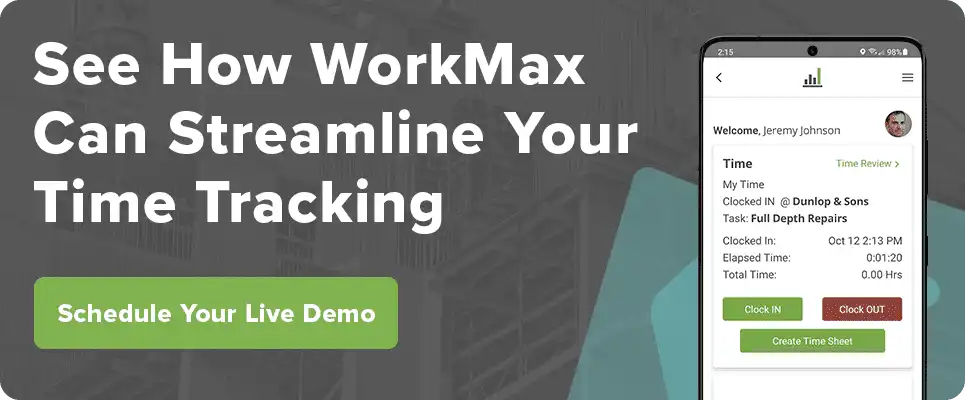
WorkMax® Offers Time Tracking for California Labor Law Compliance
With so many moving parts — crews working variable shifts, scattered jobsite locations, evolving labor rules — accurate time tracking is essential to staying compliant with California’s regulations.
WorkMax offers a construction-first time tracking solution built to handle everything California timekeeping laws throw your way.
From logging daily overtime to tracking rest breaks and separating piece-rate pay, WorkMax helps contractors:
- Capture real-time, GPS-stamped labor data
- Automate compliance with daily and weekly overtime rules
- Track breaks and non-productive time
- Generate detailed audit trails for wage statements
Whether you’re running union or non-union jobs, on public or private projects, WorkMax gives you the tools to manage labor confidently and avoid costly mistakes.
Learn how WorkMax can help your crew stay productive and your business stay compliant with California timekeeping laws.
Chat with a specialist today.